
President Herzog Pardons IDF Soldier Despite Military Objection
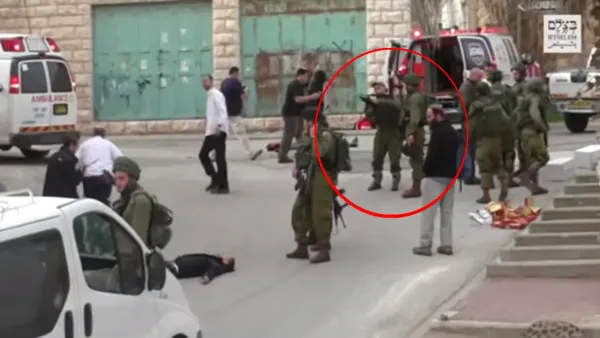
Circled in red: Elor Azaria, holding a gun moments before firing at Palestinian Abd al-Fattah al-Sharif, who was lying wounded and incapacitated on the ground. (Emad Abu-Shamsiyah/B’Tselem)
When a president grants clemency to a convicted soldier despite objections from the military leadership, the decision naturally raises questions about justice, accountability, and the meaning of mercy.
Israeli President Isaac Herzog's decision to pardon former IDF soldier Elor Azaria provides precisely such a moment. Azaria was convicted of manslaughter after shooting and killing Abdel Fattah al-Sharif, a wounded and incapacitated Palestinian in Hebron in 2016. Herzog's decision came despite opposition from senior military officials to shortening the consequences of Azaria's conviction.
That disagreement is significant. The military's position and the president's decision represent two different judgments about what should happen after a serious criminal conviction. Herzog's office cited factors including the passage of time, Azaria having completed his sentence, changed personal and family circumstances, and the remorse expressed in his clemency request.
But there is another side of the story that should not be forgotten: the person who died and the family who had to live with that loss.
The Family Left Behind
Abdel Fattah al-Sharif was not simply a name in a military investigation or a court record. He was someone's son and a member of a family that had to bury him after his death.
Yet according to reports, Israeli authorities held al-Sharif's remains for approximately two months before returning them to his family.
That detail deserves greater attention because it has a religious as well as a deeply human significance.
A Shared Jewish and Muslim Tradition
Many people may be unaware that both Jewish and Islamic traditions place profound importance on burying the dead promptly.
In traditional Jewish law, a deceased person is generally to be buried within 24 hours of death, unless circumstances provide a legitimate reason for delaying the burial. Jewish tradition treats the prompt burial of the dead as a serious religious obligation.
Islamic tradition likewise places strong importance on prompt burial. The deceased should ordinarily be buried as soon as reasonably possible, with delays permitted when circumstances require them.
The two religious traditions are not identical in all their rules, but they share an important principle: the dead should be treated with dignity, and burial should not be unnecessarily delayed.
This makes the approximately two-month withholding of al-Sharif's remains more than a procedural detail. For his family, the death of their son was followed by a prolonged wait before they could receive his remains and carry out his burial.
To put it plainly: the suffering did not necessarily end when al-Sharif died. His family continued to experience the consequences of his death while waiting for his remains to be returned.
Clemency and the Question of Consistency
This brings us back to President Herzog's decision.
Clemency is an extraordinary power. It can recognize rehabilitation, changed circumstances, remorse, or other considerations that a president believes justify mercy. But whenever clemency is granted, it also raises questions about the victim and the victim's family.
What weight should be given to the suffering of the person who was killed?
What consideration should be given to the family who lost a loved one?
And how should those considerations be balanced against the rehabilitation or changed circumstances of the person who committed the crime?
These are not easy questions, and reasonable people can disagree about how clemency should be exercised.
But one thing should not be lost in the discussion: there were two families at the center of this tragedy—the family of the convicted soldier and the family of the man who was killed.
The former received the benefit of a presidential act of mercy. The latter had to live with the permanent loss of a son and, according to reports, waited approximately two months to receive his remains.
A Question Worth Asking
The decision also brings to mind the case of Yigal Amir, who assassinated Prime Minister Yitzhak Rabin in 1995 and remains imprisoned.
The circumstances and crimes in the two cases are obviously different. The comparison is not intended to suggest that they are legally identical.
Rather, it raises a question about the principles of clemency itself.
If time, changed circumstances, rehabilitation, and remorse can be considered when presidential clemency is granted in one case involving a killing, what principles determine when those same considerations should—or should not—apply in another?
That is the question behind the title of my earlier column.
And perhaps the most important question is an even more human one:
When mercy is extended to the person who committed the killing, how do we make sure that we do not forget the person who was killed—and the family who continues to mourn?
Mahmoud El-Yousseph is a Palestinian freelance writer and retired U.S. Air Force veteran. He writes about U.S. foreign policy, Middle Eastern affairs and justice.